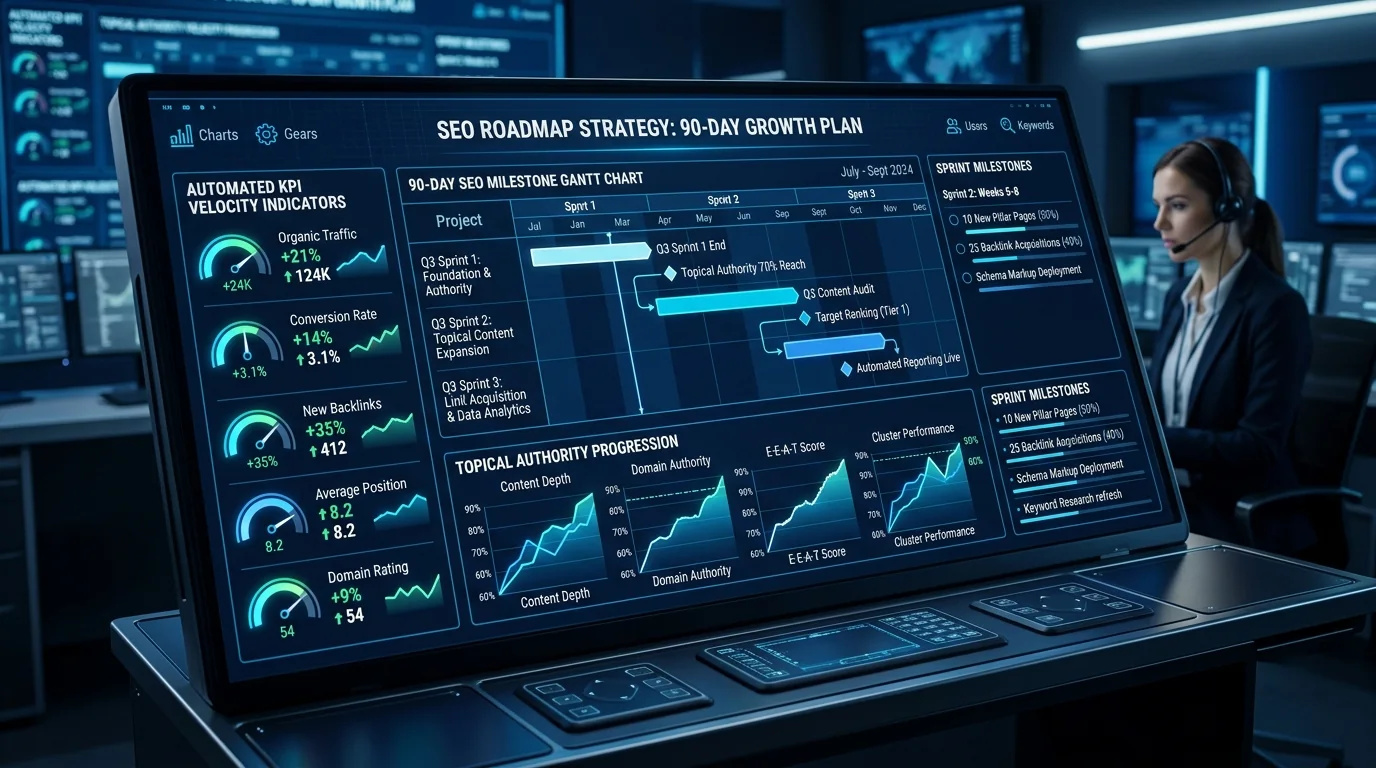
Universal AI SEO Strategy & Planning: 10-Phase Topical Authority Roadmaps
SEO planning is the systematic architecture of entity-attribute relationships, source context crystallization, and phased publication sequencing designed to establish indisputable semantic authority in search engines. Modern topical authority is not achieved through random keyword production; it requires a deterministic mathematical hierarchy where macro pillars, symmetric twin topics, and directional internal linking conduits are deployed in structured waves. seoskillsai.com automates the entire Holistic Semantic Topical Authority Framework across Anthropic Claude Code (MCP), Google Antigravity IDE, OpenAI ChatGPT Actions, Cursor IDE, and Nous Hermes Agents.
⚡ Direct Execution Centerpiece: Autonomous Topical Map Generator
Execute this command in your terminal to ingest a keyword list or competitor domain and automatically generate an end-to-end 10-phase topical authority roadmap with entity-attribute clustering:
# Generate a 10-Phase Topical Authority Plan via Universal CLI
npx @seoskillsai/cli plan --domain="https://yourdomain.com" --phases=10 --twin-topics --output=csv

# Claude Code CLI Topical Map Ingestion
claude mcp call seoskillsai generate_topical_plan '{"central_entity": "AI SEO", "phases": 10}'

# Google Antigravity Native Skill Invocation
/seo-plan central_entity="Universal AI SEO" competitor_csv="competitor_keywords.csv"
┌─────────────────────────────────────────────────────────────────────────────┐
│ 10-PHASE TOPICAL AUTHORITY DEPLOYMENT MATRIX                                │
├───────┬──────────────────────────────────┬──────────────────────────────────┤
│ Phase │ Strategic Purpose                │ Architectural Deliverables       │
├───────┼──────────────────────────────────┼──────────────────────────────────┤
│ P01   │ Macro Core Foundation            │ Homepage, /skills Hub, 5 Pillars │
│ P02   │ Tier-1 Flagship Ecosystems       │ Claude, Antigravity, ChatGPT     │
│ P03   │ In-IDE Coding Agents             │ Cursor, Windsurf, Cline VS Code  │
│ P04   │ Open-Source & Local Agents       │ Nous Hermes, DeepSeek, Aider     │
│ P05   │ Technical Infrastructure         │ Sitemaps, Prerender, Hreflang    │
│ P06   │ GEO & 2026 AI Search             │ Grok, Perplexity, llms.txt       │
│ P07   │ Knowledge Graph & Vectors        │ Semantic Triples, Factuality     │
│ P08   │ Interactive Utility Tools        │ Web Calculators, JSON Converters │
│ P09   │ Commercial Vertical Silos        │ E-Commerce, Local, Programmatic  │
│ P10   │ Comparative Benchmarks & Moats   │ Deep SaaS Comparisons, DAG Flow  │
└───────┴──────────────────────────────────┴──────────────────────────────────┘
🏛️ The 4 Pillars of Holistic Semantic Semantic Architecture
graph TD
    SC["1. Source Context Crystallization<br/>(What is this site fundamentally about?)"] --> CD["2. Contextual Domain Definition<br/>(What are the strict topical boundaries?)"]
    CD --> EAM["3. Entity-Attribute-Value Modeling<br/>(Which entities define the niche?)"]
    EAM --> STT["4. Symmetric Twin Topics<br/>(Parallel multi-agent capability clusters)"]
    STT --> DIL["Directional Internal Link Flow<br/>(Outer Leaf -> Core Pillar -> Hub)"]
1. Source Context Crystallization
Before search engines can award high topical rankings, they must clearly classify the website's Source Context. If an AI search platform publishes unrelated e-commerce coupons or generic celebrity gossip, its source context is polluted. We anchor seoskillsai.com as the definitive developer standard for autonomous search optimization.
2. Contextual Domain & Silo Segregation
A contextual domain defines what is inside and outside the topical scope. Our architecture establishes 9 strict silos (Diagnostics, Planning, Schema, Copywriting, Backlinks, Clustering, GEO, Tooling, CMS Integration). Pages within a silo link downward and horizontally, but cross-silo links occur only through contextual bridge anchors.
3. Entity-Attribute-Value (EAV) Modeling
Search engines perceive topics as nodes in a knowledge graph with distinct attributes:
- Entity: Claude Code SEO Skill
- Attributes: Runtime Protocol (MCP), Context Window (200k), Execution Interface (CLI), Tool Types (Filesystem, Web)
- Values: Model Context Protocol, Claude 3.7 Sonnet, Bash Shell, JSON Schemas
4. Symmetric Twin Topics
When introducing an optimization capability (e.g., seo-audit), it must be deployed across all parallel agent entities symmetrically:
/claude/seo-audit $\leftrightarrow$ /antigravity/seo-audit $\leftrightarrow$ /chatgpt/seo-audit $\leftrightarrow$ /cursor/seo-audit
This mathematical symmetry signals complete topical coverage without semantic blind spots.
💻 Multi-Agent Strategic Planning Scripts
1. Python Automated 10-Phase Clustering Script
Run this script to partition raw keyword exports into structured publication phases:
import csv
from collections import defaultdict

def build_publishing_phases(keyword_file: str):
    with open(keyword_file, 'r', encoding='utf-8') as f:
        reader = csv.DictReader(f)
        keywords = list(reader)

    phases = defaultdict(list)
    for kw in keywords:
        vol = int(kw.get('Volume', 0) or 0)
        silo = kw.get('Silo', 'General')

        # Phase 1: Core Macro Pillars & Hubs
        if kw.get('Page Type') == 'Core' or vol > 1000:
            phases['Phase 1: Macro Foundation'].append(kw)
        elif 'Claude' in silo or 'Antigravity' in silo or 'ChatGPT' in silo:
            phases['Phase 2: Tier-1 Flagships'].append(kw)
        elif 'Cursor' in silo or 'Windsurf' in silo:
            phases['Phase 3: In-IDE Agents'].append(kw)
        else:
            phases['Phase 4+: Supporting Depth'].append(kw)

    for phase_name, items in phases.items():
        print(f"[+] {phase_name}: {len(items)} nodes mapped.")

if __name__ == "__main__":
    build_publishing_phases("rebuild-strategy.csv")
❓ Frequently Asked Questions
How do I build a 10-phase topical authority plan using Holistic Semantic methodology?
Start by defining your central entity and source context in Phase 1 (Macro Pillars). In Phase 2, deploy your highest-authority flagship entities. Follow with IDE tools (Phase 3), open-source agents (Phase 4), technical infrastructure (Phase 5), and GEO standards (Phase 6), culminating in commercial verticals and comparative benchmarks.
What is the difference between source context and contextual domain?
Source context defines the primary identity and overarching purpose of the domain (e.g., Universal AI SEO Platform). Contextual domain defines the strict thematic boundaries and sub-disciplines that the site covers without diluting topical authority.
How do symmetric twin topics prevent topical authority gaps?
Symmetric twin topics ensure that every capability offered for one entity (e.g., Claude SEO Audit) is symmetrically implemented for all parallel entities (Antigravity SEO Audit, ChatGPT SEO Audit), proving to Google that the domain covers the complete entity graph.
🔗 Connected Authority & Phase 1 Macro Pillars