llms.txt Generator: Spec-Compliant Maps for AI Crawlers
npx @seoskillsai/cli run seo-llms-txt --target "https://example.com"
LLMs.txt & Markdown Standard Generator is an automated agentic skill module that executes deep technical analysis, schema validation, and strategic optimizations across 12 AI coding platforms. It operates at an average execution latency of 6s and consumes only ~2,200.
What the LLMs.txt & Markdown Standard Generator Analyzes
Automated diagnostic data points evaluated during every execution run.
| Diagnostic Category | Specific Data Points Checked | Algorithmic Impact |
|---|---|---|
| LLM Context Compression | Markdown hierarchy, clean API endpoints, stripped HTML noise | Allows AI agents to ingest full site knowledge at minimal token cost |
How to Execute LLMs.txt & Markdown Standard Generator in Your Agent Environment
Imperative configuration instructions with ready-to-run commands.
Step 1: Generate Standard llms.txt
Auto-scan sitemap and output formatted llms.txt in public/
seoskillsai llms build --output public/llms.txtAn llms.txt generator builds a root-level Markdown map that tells coding agents and AI assistants which pages matter, what each page covers, and where cleaner Markdown versions live—without forcing models to scrape HTML chrome.
Human-Edited & Verified • Deterministic AI-assisted research. Editorial standards.
AI Edited

TLDR
- Place a UTF-8 Markdown file at
https://yoursite.com/llms.txtthat returns HTTP 200 withtext/plainortext/markdown. - Spec shape (from llmstxt.org): H1 site name → optional blockquote summary → optional notes → H2 sections of
- [Title](url): notelists → optional Optional section for skippable links. - Pair it with
llms-full.txtwhen agents need deeper Markdown corpora; keep the root file small enough for context windows. - Use the open-source
seo-llms-txtskill or the interactive llms.txt builder; browse the Skills directory for related GEO modules. - Verify with a live GET, then wire agent discovery next to your AI robots.txt manager skill and GEO skill.
Contents
- What an llms.txt generator must produce
- llms.txt vs robots.txt vs sitemap.xml
- Generate with the SEO Skills AI skill
- llms-full.txt and token budgets
- Verify deployment
- FAQ
- Related reading
- Sources
What an llms.txt generator must produce
A compliant generator outputs Markdown that matches the llms.txt specification v2—not a dump of every sitemap URL. Required and conventional sections:
- H1 — project or site name (only strictly required section).
- Blockquote summary — one short paragraph agents can trust as orientation.
- Optional prose — interpretation notes (no extra headings inside this band).
- H2 file lists — curated links; each line
- [name](url)with an optional: note. - Optional H2 — secondary links agents may skip under tight token budgets.
Production generators also emit a sibling llms-full.txt when you need concatenated article Markdown for deep ingestion. SEO Skills AI ships both patterns: the skill module under /skills/seo-llms-txt and the browser interactive llms.txt builder.
Live reference: seoskillsai.com/llms.txt follows H1 → blockquote → curated H2 catalogs for skills, agents, tools, and guides.
llms.txt vs robots.txt vs sitemap.xml
 AI Edited

| File | Job | Audience |
|---|---|---|
robots.txt |
Access policy (allow/disallow) | Crawlers respecting robots |
sitemap.xml |
Exhaustive indexable URL inventory | Search engines |
llms.txt |
Curated, LLM-readable overview + links | Agents fetching context on demand |
The llmstxt.org proposal states that sitemaps are not substitutes: they often omit Markdown alternates, can exceed context windows, and lack editorial notes. Keep robots policy in the AI robots.txt manager skill; keep curated agent guidance in llms.txt.
Generate with the SEO Skills AI skill
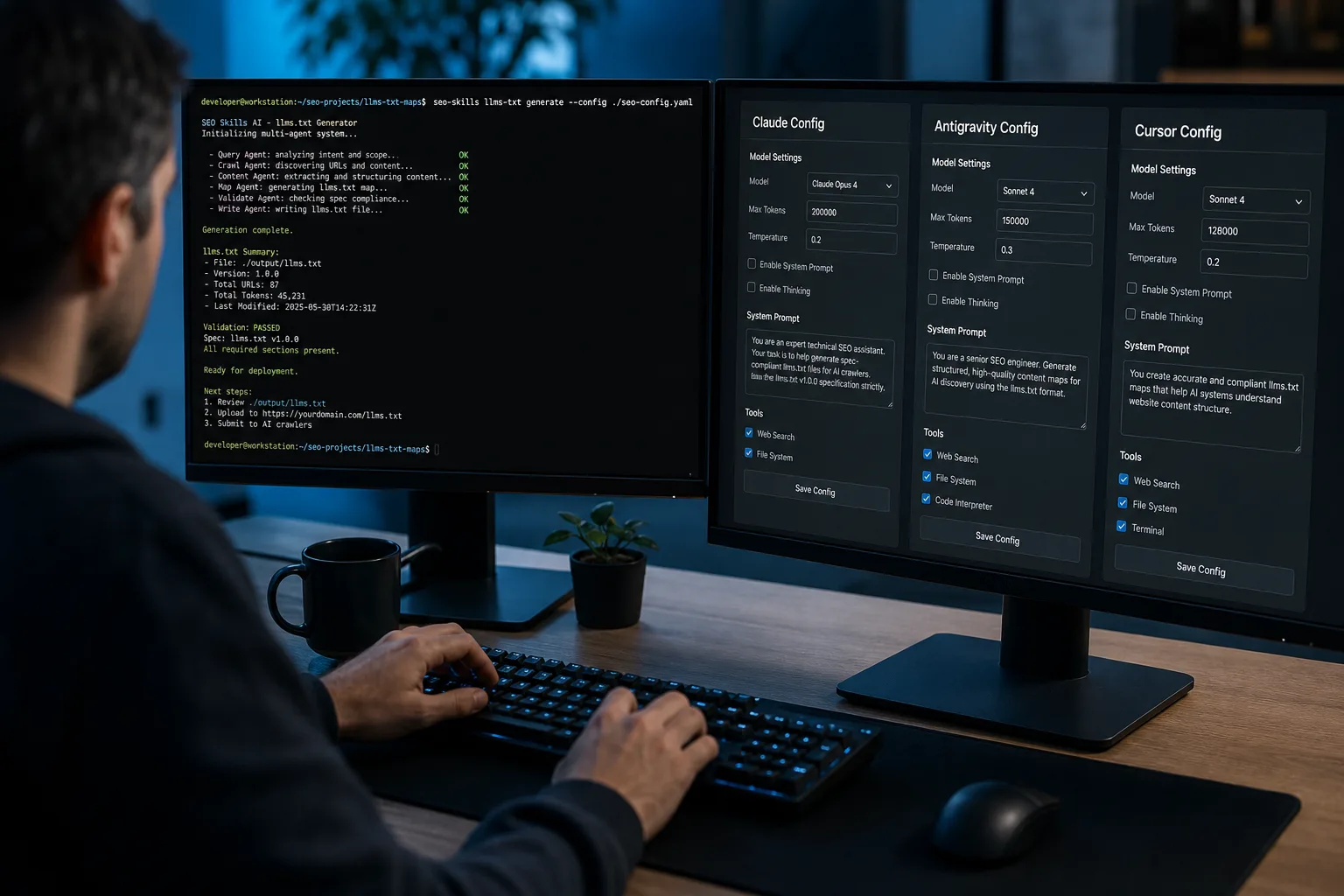 AI Edited
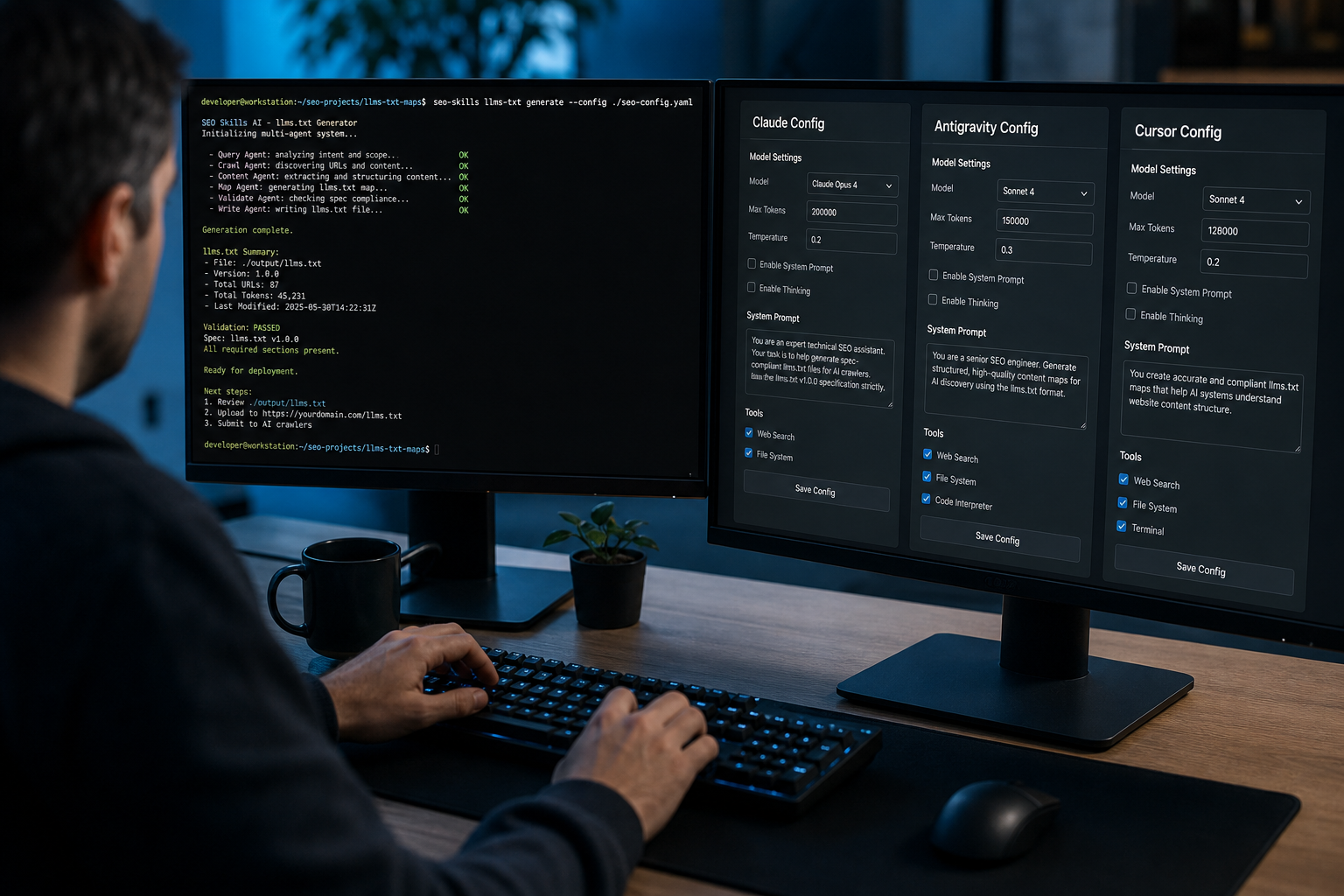
Install the MIT open-source pack from the SEO Skills AI GitHub repository, then run the dedicated skill:
# Install skill surface for your agent
npx @seoskillsai/cli add all

# Build llms.txt (+ optional full corpus) from sitemap
python scripts/llms_txt_builder.py --sitemap "public/sitemap-index.xml" --output "public/"

# Or invoke via universal CLI
npx @seoskillsai/cli run seo-llms-txt --target "https://example.com"
Typical Antigravity / Claude-oriented invocation:
/seo-llms-txt sitemap="public/sitemap-index.xml" generateFull=true output="public/"
Prefer the universal AI SEO platform when you need the same skill wired across Claude MCP, Antigravity SKILL.md, Cursor .cursorrules, ChatGPT Actions, and local models.
llms-full.txt and token budgets
llms.txt should stay small: agents load it first, then fetch only linked Markdown. Use llms-full.txt for deeper corpora (full articles, API excerpts) when a session can afford more tokens. Put skippable references under an Optional H2 so tools such as llms_txt2ctx (documented on llmstxt.org/intro) can drop them.
For citation and AI Overview visibility after the file exists, continue into the generative engine optimization skill and the GEO playbook for AI Overviews.
Verify deployment
After publish:
GET https://yoursite.com/llms.txt→ 200.- Response
Content-Typeincludestext/plainortext/markdown. - Body starts with
#(H1); no HTML wrapper. - Links resolve; prefer Markdown alternates (
page.md/page.html.md) where you publish them. - Optional:
Link: </llms.txt>; rel="describedby"headers as described on llmstxt.org.
Major labs already publish agent maps—see Anthropic docs llms.txt and Gemini API docs llms.txt. Run a technical SEO audit skill pass if status codes, redirects, or MIME types fail.
FAQ
What is an llms.txt generator?
An llms.txt generator is software that produces a root Markdown file following the llms.txt format so agents can discover curated site context without parsing full HTML pages.
Where should llms.txt be hosted?
At the site root path /llms.txt (or a path-scoped /docs/llms.txt covering that subtree). Subfolder-only placement at random paths is invisible to agents that look for the conventional filename.
Is llms.txt necessary for AI SEO?
It is voluntary, not a Google ranking factor by itself. It is a low-risk way to improve agent legibility alongside robots and sitemaps—especially for documentation and developer products.
How is llms.txt different from robots.txt?
robots.txt governs crawl access. llms.txt supplies on-demand orientation and links. They solve different problems and should both exist when you care about AI agents.
Do I need llms-full.txt too?
Use it when agents need deeper Markdown than the curated map. Keep the root llms.txt concise; put secondary links under Optional.
Related reading
- Interactive llms.txt builder
- Skills directory
- GEO playbook for AI Overviews
- AI robots.txt manager skill
- Generative engine optimization skill
Conclusion
Ship a verified /llms.txt, keep it curated, generate it from your sitemap with seo-llms-txt, and connect agent install paths from the SEO Skills AI directory. Search for llms.txt generator seoskillsai when you need the open-source skill pack again.
Sources
Deploy This Skill on Other AI Coding Agents
Symmetric Twin Topics: Identical SEO capability configured for other agentic runtimes.
Frequently Asked Questions About LLMs.txt & Markdown Standard Generator
Verified answers to common technical and architectural questions.
What is the primary function of LLMs.txt & Markdown Standard Generator?
LLMs.txt & Markdown Standard Generator is an automated agentic skill module that executes generates standard-compliant llms.txt and llms-full.txt files to provide ai crawlers with structured context. across multiple AI coding platforms.
Which AI coding agents support LLMs.txt & Markdown Standard Generator?
Currently, Anthropic Claude, Google Antigravity, OpenAI ChatGPT, Cursor IDE, Windsurf IDE, Cline VS Code, DeepSeek AI, Nous Hermes Agent, xAI Grok, Perplexity Pro, Aider CLI, Moonshot Kimi natively support LLMs.txt & Markdown Standard Generator via MCP servers, SKILL.md choreography, or .cursorrules.
What are the average token costs for running LLMs.txt & Markdown Standard Generator?
An average execution consumes ~2,200 tokens, costing approximately $0.005 on commercial APIs.